
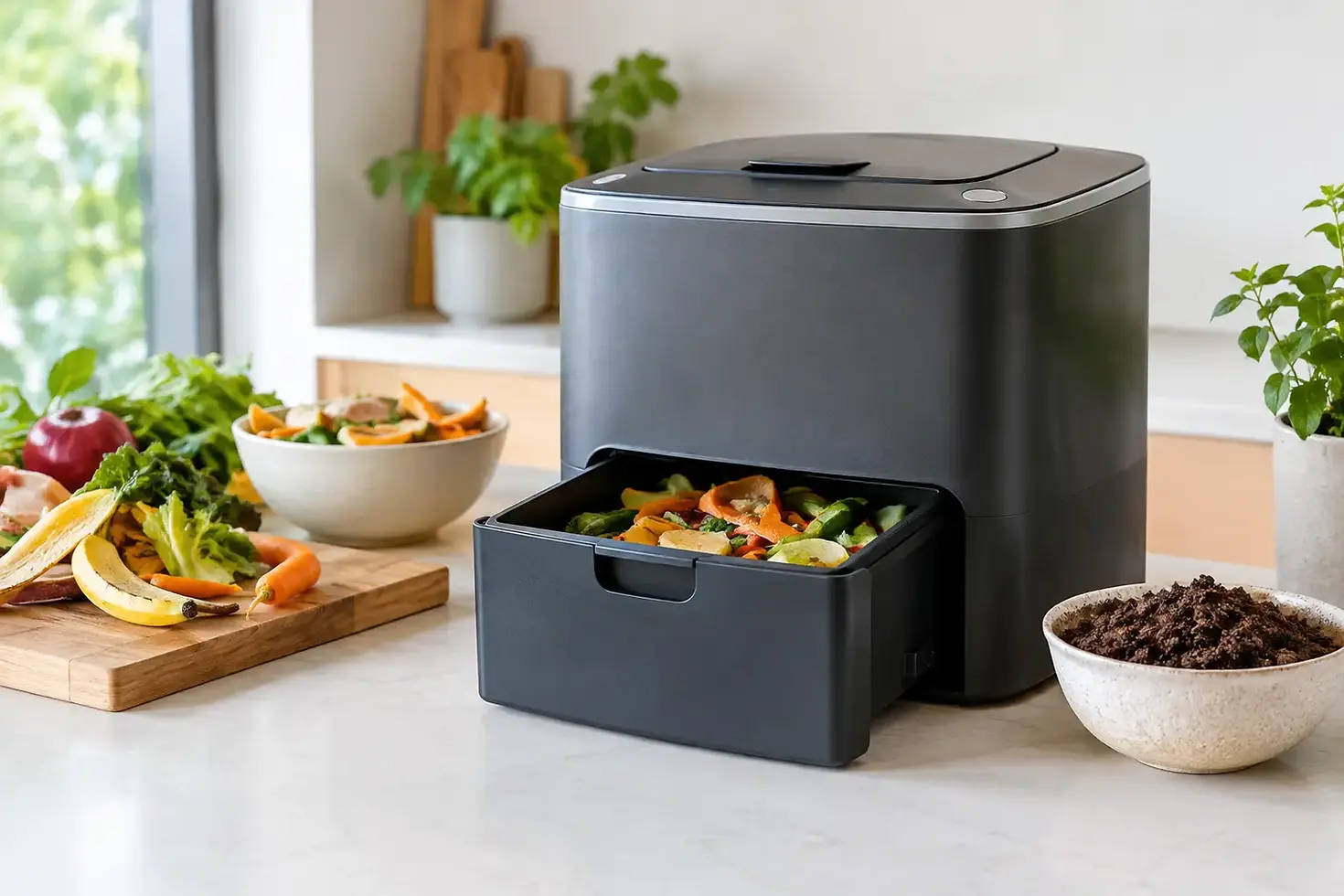
Food Waste Compost Machine Reviews That Matter
A countertop unit can make a week’s peelings disappear from sight by morning. That is appealing in an apartment, a busy family kitchen, or a small commercial pantry. But food waste compost machine reviews often blur an essential distinction: reducing food scraps is not always the same as making compost.
For households and organizations trying to keep organic matter out of landfill, that distinction shapes the value of every purchase. A machine may dry, grind, or heat scraps into a lighter material. A true composting system supports decomposition, then allows the resulting organic matter to mature into a stable soil amendment. Both approaches can have a place. They should simply be judged honestly, according to the outcome you need.
What a Compost Machine Is Actually Doing
Many electric kitchen machines are best understood as food-waste processors. They use heat, airflow, agitation, and sometimes grinding to reduce volume and moisture. The output is dry, broken-down material that is easier to store, less likely to smell, and more convenient to add to a compost pile or send to an organics collection service.
This can be genuinely useful. Less moisture means less weight, and a closed unit can help households manage scraps between collections. For a café or office, pre-processing may improve cleanliness and make back-of-house food-waste handling more manageable.
Yet the output is not necessarily finished compost. Compost is created through biological activity. Microorganisms need moisture, oxygen, a balanced supply of carbon-rich and nitrogen-rich materials, and sufficient time to transform fresh food residues into stable organic matter. Mature compost has an earthy smell and crumbly texture. It does not resemble dried fragments of last night’s meal.
Some larger on-site systems do use controlled aeration, mixing, and temperature management to create conditions for active composting. These systems can be highly effective when they are properly sized, loaded with the right material mix, and given time for curing. They also require more than the push-button convenience suggested by many countertop products.
How to Read Food Waste Compost Machine Reviews
The strongest reviews tell you what happens after the cycle ends. The weakest focus only on speed, a sleek design, or the fact that a bucket holds fewer scraps than before.
Start by looking for plain language about the output. If a review calls it “compost,” check whether the reviewer has allowed the material to mature, tested it in soil, or mixed it into an existing compost system. If it is a dehydrated food-waste product, it may still be useful, but it should not be spread heavily around plants without understanding its salt, acidity, and nutrient concentration.
Pay attention to the materials the machine accepts. Fruit and vegetable scraps are usually straightforward. Cooked food, meat, fish, dairy, oily leftovers, bones, and fibrous items such as corn husks can be more demanding. A unit that works well for occasional banana peels may struggle in a household that cooks daily or a business kitchen producing mixed food waste.
Capacity deserves more attention than it receives. Manufacturers often state capacity by volume, but a practical review explains how many days of scraps the bin holds and whether the user has to cut material into small pieces. A family of four, a restaurant prep kitchen, and a school cafeteria generate very different quantities and types of organic material. Buying a machine that is too small creates a new routine of overflow, frequent cycles, and frustration.
Odor claims also need context. Closed systems can contain smells during operation, but odors may appear when the lid opens, filters need replacement, or food sits too long before processing. Reviews written after several months are especially valuable because they reveal whether seals, filters, and cleaning routines remain effective over time.
Look Beyond the First Week
New equipment usually performs at its best when it is clean, lightly loaded, and handled carefully. Long-term reviews show the reality of maintenance. Look for details on removable parts, cleaning effort, replacement filters, blade wear, jams, noise, and warranty support.
Energy use matters too. A machine that runs for several hours uses electricity to remove water and reduce volume. That does not automatically make it a poor environmental choice, particularly if it helps prevent food waste from entering the regular trash. But it is part of the full picture. The best choice is often the one that reduces waste reliably without creating unnecessary processing, replacement parts, or transport.
The Right Machine Depends on the Next Step
Before comparing ratings, decide where your food scraps will go after treatment. This is the question that turns a product search into a practical waste plan.
If you have access to a garden compost bin, tumbler, or community composting site, a food-waste processor may be useful as a preparation tool. Its dried output can be mixed with dry leaves, shredded cardboard, or other carbon-rich browns and allowed to decompose properly. Adding it in small layers helps maintain airflow and prevents a dense, overly rich pile.
If you have no outdoor space, a managed organics collection service may be a more direct route back to soil. In that case, a countertop machine is optional rather than essential. Storing scraps in a sealed container or freezer until collection may use less energy and preserve the material for professional composting.
For businesses, the decision is broader. A restaurant, hotel, school, or residential development should consider daily volume, contamination risk, available space, staff training, cleaning requirements, and the destination of the finished material. An on-site composter can demonstrate meaningful circular practice, but it needs consistent operation and a plan for curing and using the compost. Collection may be the better fit where space, staffing, or feedstock consistency is limited.
ReSoilo approaches this choice from the point of view of decomposition rather than disposal. The aim is not simply to make food waste less visible. It is to guide organic matter through a process that protects its value and returns it to soil in a useful form.
Questions Worth Asking Before You Buy
A few focused questions can reveal more than dozens of star ratings. Ask whether the machine biologically composts materials or dries and grinds them. Ask what must be added for the output to become mature compost. Ask how often filters, liners, or other parts need replacement, and what those replacements cost over a year.
For a true composting unit, ask about the required balance of food scraps and browns. Food waste is typically rich in nitrogen and moisture, while dry leaves, wood chips, cardboard, and similar browns provide carbon and structure. Without enough browns and oxygen, even an expensive machine can produce compacted, odorous material rather than healthy compost.
Also ask what happens when the machine is full, when a cycle fails, or when staff members add unsuitable items. This is particularly important in shared kitchens. Clear signs, simple sorting rules, and a designated person responsible for the system often matter as much as the equipment itself.
A Better Standard for Reviews
The most useful food waste compost machine reviews do not promise that one appliance will solve every organic-waste challenge. They explain who the machine suits, what it requires, and how its output should be handled.
A compact dehydrating processor may suit an apartment resident who wants cleaner storage and has a reliable place to send or compost the material afterward. A tumbler or aerated composting system may suit a household with outdoor space and a steady supply of browns. A managed collection program may serve a busy household or business better than any machine, especially when the priority is reliable diversion with minimal staff effort.
Food scraps are not the end of a meal’s story. Chosen thoughtfully, the right system gives their nutrients time, air, and care to find their way back into living soil.


Comments