
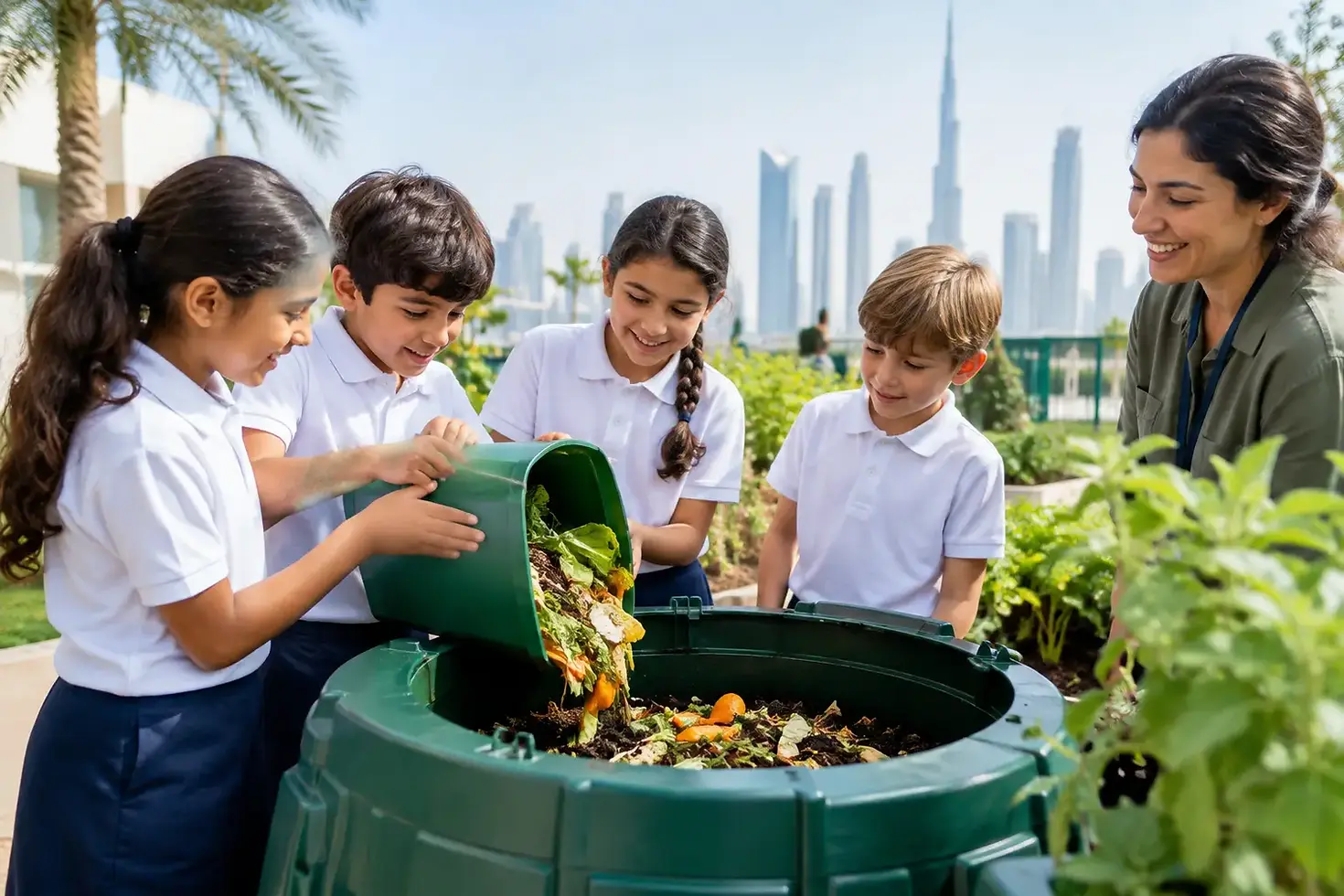
A School Composting Program in Dubai That Lasts
A school composting program in Dubai can begin with something as ordinary as a banana peel left after lunch. But for that peel to become valuable compost rather than landfill waste, the school needs more than a bin. It needs a clear route for organic material, thoughtful daily care, and a shared understanding that food scraps are part of a living cycle.
For students, composting makes environmental responsibility visible. They can see how peels, fruit cores, coffee grounds, and garden trimmings break down into dark, crumbly organic matter. For educators and facilities teams, it creates a practical way to reduce waste while supporting gardens, outdoor learning, and a more considered school culture.
Start With the Waste You Actually Generate
The strongest programs are designed around real routines, not broad sustainability promises. Before selecting equipment or setting collection schedules, observe where organic waste is created. In many schools, the main sources are cafeterias, staff rooms, event catering, and landscape maintenance.
A short waste audit over several school days can reveal what is available for composting and where contamination may arise. Separate food scraps from packaging, napkins with plastic linings, cutlery, and drink containers. A program that accepts too many unclear materials at the start can become difficult to manage, especially during busy lunch periods.
Fruit and vegetable scraps, eggshells, tea leaves, coffee grounds, and small amounts of plain cooked food are useful organic inputs. These materials are rich in nitrogen and moisture. They need to be balanced with dry, carbon-rich browns such as dry leaves, shredded uncoated paper, cardboard, or wood-based bulking material. This balance is not a technical detail to overlook. It helps create air spaces, regulate moisture, and support the microorganisms responsible for decomposition.
A school with a small garden and limited food waste may be well suited to an on-site compost tumbler or managed composting area. A larger campus, or one producing substantial cafeteria waste, may benefit more from separated collection and off-site processing. The right model depends on available space, staff capacity, the volume and type of waste, and whether the school can use finished compost on site.
Design the School Composting Program in Dubai Around Daily Habits
Dubai schools operate within a hot climate, busy campus schedules, and often highly managed food-service environments. These conditions do not prevent composting. They simply make clear systems more valuable.
Place collection stations where food waste is generated, rather than expecting students or staff to carry scraps across campus. Cafeteria stations should have visible signs with pictures of accepted items, a separate container for non-compostable waste, and adult or student guidance during the program's early weeks. A well-positioned monitor can prevent most contamination before it enters the compost stream.
Keep the first set of accepted materials simple. If the school kitchen serves meals with sauces, meat, dairy, or mixed packaged items, decide carefully whether these can be managed safely through the chosen system. An enclosed, professionally managed process may accommodate a wider range of organics than a small school garden compost bin. There is no advantage in collecting material that the school cannot process properly.
On-site composting also requires a responsible custodian. This might be a facilities team member, science teacher, gardening coordinator, or sustainability committee supported by a service partner. Their role is not to do every task alone. It is to check that the pile or system has enough browns, is neither waterlogged nor too dry, has sufficient airflow, and is progressing as expected.
In Dubai's warmer months, heat can accelerate biological activity, but it can also dry a compost system quickly. Moisture should feel similar to a wrung-out sponge: present, but not dripping. A dry pile slows down. An overly wet or compacted pile can become anaerobic and develop unpleasant odors. Regular mixing, correct material balance, and covered storage for browns help maintain favorable composting conditions.
Make Composting Part of Learning, Not a Back-of-House Task
Waste diversion matters, but a school setting offers something more enduring: the opportunity to teach nutrient cycling through direct experience. Students are more likely to care for a system when they understand what is happening inside it.
Science lessons can use compost to explore decomposers, carbon and nitrogen, soil structure, water retention, and plant growth. Younger students can identify what belongs in the compost collection. Older students can weigh inputs, track contamination, record temperatures, or compare the health of plants grown with and without mature compost.
The process also teaches patience. Food scraps do not become finished compost overnight. Materials move through active decomposition, curing, and maturation before they are ready to support plants. Explaining this process helps students see compost not as waste that has disappeared, but as a carefully transformed soil resource.
A small student eco-team can be particularly effective when its role is meaningful. Students may help create signage, guide peers at lunch stations, report weekly collection figures, or care for a school garden that receives the finished compost. Rotating responsibilities prevents the initiative from depending on one enthusiastic group of students who may graduate or move on.
Create a System That Facilities Teams Can Maintain
A composting program should add purpose to school operations, not create an unmanaged burden. Clear ownership is essential. Establish who empties cafeteria caddies, who adds browns, who monitors on-site equipment, who orders supplies, and who responds if contamination increases.
Written procedures should be brief enough to use during a busy school day. They can cover collection times, accepted materials, cleaning expectations, what to do when bins contain incorrect items, and when to transfer material to a processing unit or collection point. Training should include food-service workers, cleaning teams, teachers involved in the program, and relevant student leaders.
If space, staffing, or regulatory requirements make on-site processing impractical, managed collection is often the more dependable choice. The school can still separate food scraps, teach the underlying principles, and report its diversion results while a specialist manages processing conditions elsewhere. ReSoilo can support schools through tailored organic-waste collection, on-site solutions, and practical equipment suited to the scale of the campus.
The choice does not need to be permanent. A school may begin with an off-site collection pathway, then add a garden tumbler later for leaves and selected fruit and vegetable scraps. Another may start with a small demonstration system before expanding across food-service areas. Starting at a manageable scale is usually wiser than launching a campus-wide program without the people or processes to sustain it.
Measure What Matters
A few useful measures make the value of a school composting program visible. Track the weight or volume of organic waste collected, the level of contamination, participation by grade or cafeteria area, and the amount of finished compost used in gardens or landscaping. These figures can inform environmental reporting, student projects, and conversations with families.
Numbers should be interpreted with care. A sudden increase in collected scraps may mean the school is diverting more material from general waste, which is positive. It may also mean bins are receiving incorrect items. Pair collection data with regular checks of material quality.
The most meaningful outcomes are often both measurable and lived: cleaner sorting stations, students who understand where food waste belongs, healthier garden beds, and staff who see organic material as a resource with a destination beyond the trash bin.
Keep the Program Growing Through the School Year
School calendars change quickly. New students arrive, staff responsibilities shift, and special events can create unusual waste streams. Revisit the program at the beginning of each term, after long breaks, and before major events. Refresh labels, retrain key teams, and confirm that the supply of browns and collection capacity remains adequate.
Share progress in ways that connect the program to the school community. A notice showing how much food waste has been diverted is useful, but it becomes more compelling when paired with images of compost supporting seedlings, shade trees, or a student garden. This closes the loop in a way that a waste statistic alone cannot.
The lasting value of composting is not just that less organic material reaches landfill. It is that students learn to recognize a return path for what they consume: from cafeteria scraps, to careful decomposition, to living soil, and back to the plants that sustain a community.


Comments